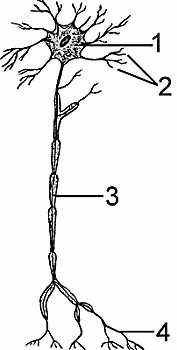
: a grayish or reddish granular cell that is the fundamental functional unit of nervous tissue transmitting and receiving nerve impulses and having cytoplasmic processes which are highly differentiated frequently as multiple dendrites or usually as solitary axons which conduct impulses to and away from the cell body: nerve cellsense 1
Examples are automatically compiled from online sources to
show current usage.Read More
Opinions expressed in the examples do not represent those of Merriam-Webster or its editors.
Send us feedback.
Flight imposes strict weight limits, so birds pack enormous numbers of very small neurons into very small brains.—
Jacek Krywko,
ArsTechnica,
23 Oct. 2026 This tiny wearable device could record thousands of individual neurons simultaneously as animals swim, play, explore, and interact naturally.—
Mrigakshi Dixit,
Interesting Engineering,
21 Oct. 2026 As neurons fire furiously over the course of the day, ROS can accumulate.—
Rowan Jacobsen,
Scientific American,
20 Oct. 2026 The total energy cost of a practical system should be assessed across the entire process, not just the neurons.—
Mike McRae 19,
New Atlas,
20 Oct. 2026 See All Example Sentences for neuron
Word History
Etymology
borrowed from German Neuron, borrowed from Greek neûron "sinew, tendon, nerve" — more at nerve entry 1
Note:
Term introduced by the German anatomist Heinrich Wilhelm Waldeyer (Heinrich Wilhelm Gottfried von Waldeyer-Hartz, 1836-1921) in "Ueber einige neuere Forschungen im Gebiete der Anatomie der Centralnervensystems," Berliner klinische Wochenschrift, 28. Jahrgang, no. 28, July 13, 1891, p. 691: "Somit besteht ein Nervenelement (eine 'Nerveneinheit' oder 'Neuron', wie ich es zu nennen vorschlagen möchte), den genannten Forschungsergebnissen … zufolge, aus nachstehenden Stücken: a) einer Nervenzelle, b) dem Nervenfortsatze, c) dessen Collateralen und d) dem Endbäumchen." — "Therefore, in accordance with the cited research results, a nerve element (a 'nerve unit' or 'neuron,' as I would like to suggest as a name), consists of the following parts: a) a nerve cell, b) the nerve process [= axon], c) its collaterals and d) the end tree [= axon terminals]." Waldeyer apparently intended -on to be taken as a suffix, indicating a unit, rather than the Greek neuter singular inflectional ending, as he utilized Neuronen as the plural in the same article. Cf. French neurone and the English variant neurone.
: one of the cells that constitute nervous tissue, that have the property of transmitting and receiving nerve impulses, and that are composed of somewhat reddish or grayish protoplasm with a large nucleus containing a conspicuous nucleolus, irregular cytoplasmic granules, and cytoplasmic processes which are highly differentiated frequently as multiple dendrites or usually as solitary axons and which conduct impulses toward and away from the cell body: nerve cellsense 1


 Copy Citation