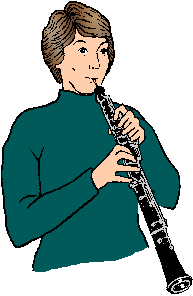
: a double-reed woodwind instrument having a conical tube, a brilliant penetrating tone, and a usual range from B flat below middle C upward for over 2½ octaves
Examples are automatically compiled from online sources to
show current usage.Read More
Opinions expressed in the examples do not represent those of Merriam-Webster or its editors.
Send us feedback.
Noun
The sort of uncool even someone very uncool like me would have known enough to conceal—me who wore khakis and played oboe and had braces and yes for a phase had basically no friends.—Literary Hub,
18 Dec. 2025 Françaix uses the wind ensemble to create a lively back-and-forth between the bright timbres of flutes and oboes and the richer tones of clarinets and bassoons.—
Sheila Regan,
Twin Cities,
7 Nov. 2025 As a freshman, Brandon began to double on the clarinet and oboe while continuing to play his main instrument, the alto saxophone.—
Heide Janssen,
Oc Register,
15 Mar. 2026 The woodwind quintet—featuring flute, oboe, clarinet, bassoon and French horn—has a repertoire that blends light classical favorites by composers like Mozart and Debussy with iconic themes from film scores.—
Anne Gelhaus,
Mercury News,
5 July 2026 See All Example Sentences for oboe
: a musical instrument in the form of a slender tube that has a distinctive bright sound and that is played by blowing into a mouthpiece holding two reeds
from Italian oboe "oboe," from French hautbois (same meaning), from haut "high" and bois "wood"
Word Origin
The musical instrument we now call an oboe was developed in France in the 17th century. The French called it a hautbois, a word pronounced something like English "o boy" and made up of haut, meaning "high," and bois, meaning "wood." The hautbois was the highest pitched member of a group of woodwind instruments played with a reed. For a time the English simply used the French word for the instrument. Sometimes they spelled it hautbois, sometimes hautboy, and sometimes they changed the spelling to oboy or hoboy. Meanwhile, the Italians took the French word as oboe, a spelling closer to the way they pronounced it. In the 18th century it became fashionable in England to prefer Italian musical terms. The English then started using the form oboe instead of hautbois, and so oboe is the form we use today.


 Copy Citation